
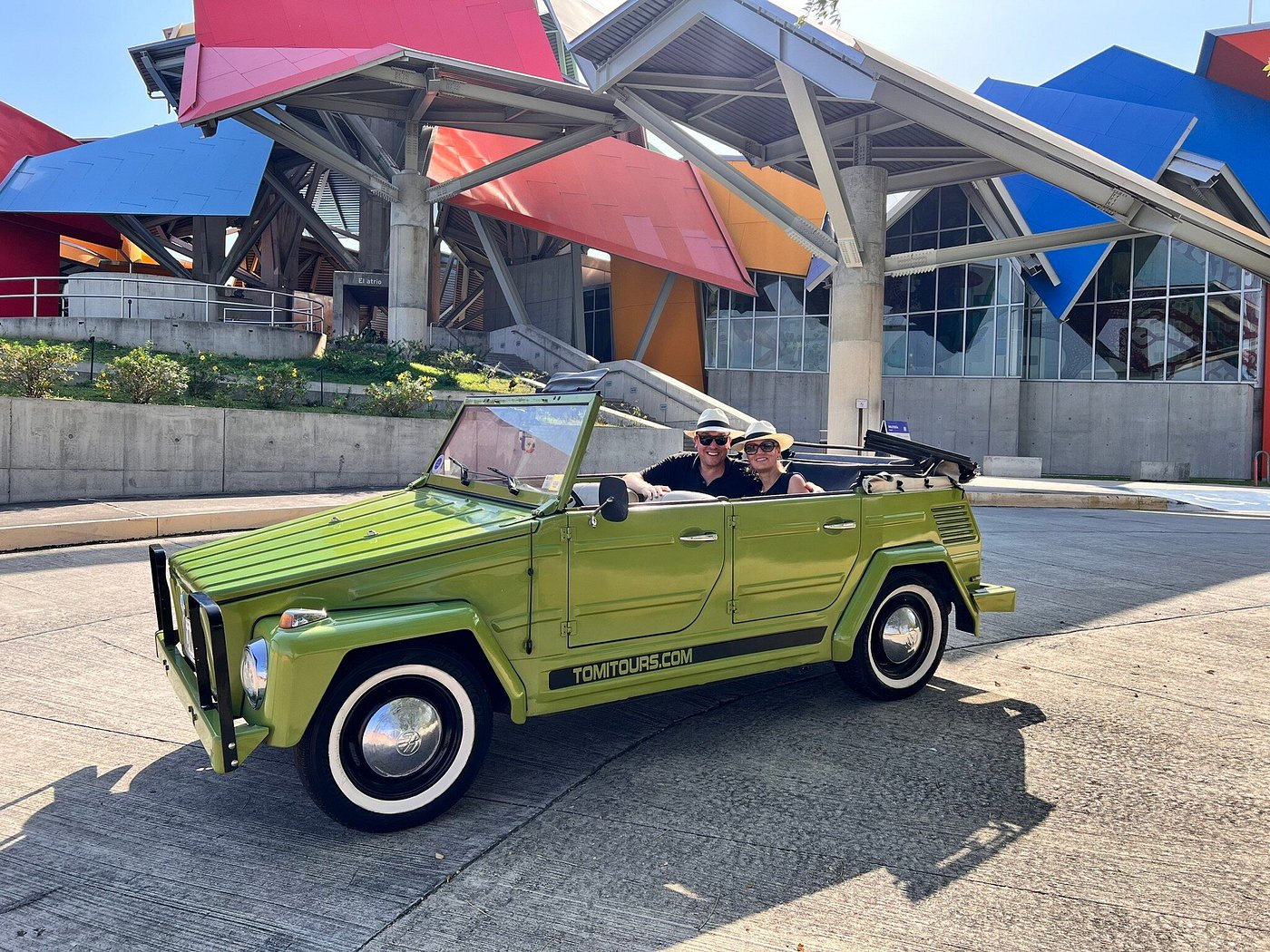
At Tomi Tours, one of our favorite aspects of sharing Panama City with guests is revealing the lesser-known stories that often go unnoticed. Whether exploring aboard our iconic yellow, green, or orange VW Safari vehicles, cruising through the city in our beautifully VW yellow and bright orange safari, or enjoying a solo adventure in our classic VW Dune Buggy, visitors quickly discover that every street has a story waiting to be told.
The Original Panama City
Many travelers are surprised to learn that the city they visit today is actually Panama’s second capital.
The original settlement, known as Panamá Viejo, was founded in 1519 and became the first permanent European city established on the Pacific coast of the Americas.
From this strategic location, Spanish explorers launched expeditions throughout the region, while treasure from Peru crossed the isthmus on its way to Europe.
For over 150 years, Panamá Viejo served as one of the most important cities in the Spanish Empire.
However, its prosperity also attracted unwanted attention.
In 1671, the infamous Welsh privateer Henry Morgan attacked and destroyed much of the city, leaving behind ruins that still stand today.
The remains of Panamá Viejo provide a remarkable glimpse into the earliest chapters of Panama’s history and remain one of the country’s most important archaeological sites.
Why Casco Viejo Exists
Following the destruction of Panamá Viejo, Spanish authorities decided to rebuild the city in a more defensible location.
The result was Casco Viejo, founded in 1673.
Unlike the original settlement, the new city was constructed on a small peninsula that could be better protected from future attacks.
Thick defensive walls surrounded the district, helping shield residents from pirates and invaders.
Today, many visitors admire Casco Viejo’s beautiful architecture without realizing that the neighborhood was originally designed as a fortified city.
As guests walk through its narrow streets, they are following pathways that have witnessed centuries of political change, international trade, revolutions, and cultural evolution.
The Forgotten Influence of Global Trade
Long before the Panama Canal existed, Panama served as one of the world’s most important trade routes.
Spanish treasure, gold, silver, spices, and goods from across South America crossed the isthmus on their way to Europe.
This made Panama one of the wealthiest and most strategically valuable locations in the Americas.
The city’s importance attracted merchants, adventurers, diplomats, and traders from around the world.
Many of the cultural influences that define modern Panama today can be traced back to this period of international exchange.
Ancón Hill and the Canal Era
Few places better illustrate Panama’s modern history than Ancón Hill.
Overlooking the city, this iconic landmark has witnessed every major transformation in Panama’s development.
During the construction of the Panama Canal, Ancón Hill became closely associated with the American administration of the Canal Zone.
For decades, the hill symbolized the complex relationship between Panama and the United States.
Today, the giant Panamanian flag that flies from its summit serves as a powerful reminder of the country’s sovereignty and national identity.
Visitors who reach the top are rewarded not only with spectacular views but also with a deeper appreciation for Panama’s historical journey.
The Hidden Stories Behind Avenida Balboa
Many people see Avenida Balboa simply as a modern waterfront boulevard lined with skyscrapers.
Yet beneath this modern appearance lies a fascinating story of transformation.
Much of the land occupied by today’s avenue did not originally exist.
Large portions were created through land reclamation projects that expanded the city’s coastline over many decades.
The avenue represents Panama City’s evolution from a historic port into one of Latin America’s most modern urban centers.
As guests cruise along Avenida Balboa in our classic Volkswagen fleet, they experience a road that symbolizes both Panama’s past and its future.
The Canal’s Impact Beyond Engineering
The Panama Canal is often celebrated as an engineering masterpiece, but its impact extends far beyond technology.
The Canal transformed Panama socially, economically, and culturally.
Workers arrived from the Caribbean, Europe, Asia, and North America, bringing traditions that helped shape the country’s multicultural identity.
Neighborhoods, businesses, schools, and communities emerged as a result of Canal construction.
The influence of this period remains visible throughout the city today.
A City of Layers
What makes Panama City so fascinating is that multiple eras coexist within a single destination.
Ancient indigenous heritage exists alongside Spanish colonial history.
Colonial churches stand beside glass skyscrapers.
Historic plazas are located minutes from one of the world’s busiest financial districts.
Every neighborhood reveals another chapter of the city’s story.
Every street contains traces of previous generations.
Discovering History Through Experience
History becomes far more meaningful when experienced firsthand.
Standing inside the ruins of Panamá Viejo, walking through the plazas of Casco Viejo, observing ships entering the Canal, or driving along the waterfront provides context that no textbook can fully capture.
At Tomi Tours, we believe that understanding Panama City’s hidden history helps visitors connect more deeply with the destination.
Because Panama is not simply a place people visit.
It is a place shaped by centuries of global influence, cultural exchange, innovation, and resilience.
And for those willing to look beyond the obvious landmarks, its most fascinating stories are often hidden in plain sight.
Book Now!!!